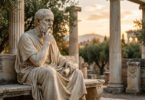


Immanuel Kant, with absolute rightness and accuracy, gathered his queries of “What can I know?”, “What ought I to do?”, and “What may I hope?” under the single overarching question: “What is man?”. I wish to evaluate these “Kant’s 4 Fundamental Questions” within the context of man and God. I choose to approach the subject from this angle because when we draw a line on the canvas of existence, if man stands on one side of that line, on the other side there can only be God. The truest path to follow is to handle these 4 fundamental questions in a way that neither reason nor God would object to—not through a blind and cheap fatalism, but by giving both reason and God their due.
No matter how much man strives to reason and be in the right—even if he is indeed right and correct—he remains bound within his own time and space. Whatever happens, every action and thought of man is the work of a created being. The Creator, on the other hand, is far removed from time and space. To look at things through the view of One who knows better than us—One who also knows what we do not know about that very matter—is not taking the easy way out; rather, it is the healthiest action one can take to find what is true. At least, what is closer to the truth. Just like everything else, correctness and rightness have degrees. The height of this degree is related to one’s closeness to God. For he who draws closer, knows more. Since closeness is a matter of the heart, its perspective is also crucial for a resolution. Although the subject is intellectual, while reason advances swiftly along its path, it is the heart that prevents it from crashing into the barriers.
Your share of the boundless sea is strictly limited by the size of your vessel.
What Can I Know?
The absolute ultimate thing a human being can know—the highest portion one can derive from the act of knowing—is that one knows nothing at all. No matter what a person assumes they know, this is the inevitable destination. For regarding whatever one presumes to master, there is always One who knows what they do not.
If you were to approach the shore of an infinite ocean holding a single cup and were granted permission to draw as much as you desired, you could still only take what your cup holds. Even if someone lifted the entire ocean and poured it into your vessel, its capacity would remain the ultimate boundary. Your share of the boundless sea is strictly limited by the size of your vessel. Thus, the question “What can I know?” is synonymous with “How much can I know?”
Just as a person’s sustenance, worn garments, total heartbeats, and allocated breaths are measured and numbered, so too is their capacity for knowledge. All of these are forms of divine provision (rizq). A person receives a portion of these allocated shares in this life and another in the lives to come. The only distinction is that while physical consumption ends with this earthly existence, one’s portion of knowing continues wherever existence persists.
To answer “What can I know?” simply with “Only your allotted share” is accurate, yet superficial. Because what a human being can know is known to God but unknown to man, the pursuit of knowing has no ultimate limit—nor should it ever have one for humanity.
We have all witnessed individuals who are genuinely afraid to learn. They fear knowledge because—whether believer or non-believer—everyone understands that one is accountable for what one knows, precisely to the extent of that knowledge. This fear holds them back from seeking more, causing them to halt their own progression. These are the ones deprived of a true portion of knowing. Their efforts yield benefit only to themselves, and strictly within the bounds of this worldly life. They choose this state deliberately, serving their own immediate self-interest. Curiosity is the sole wind that moves the boat of intellect; yet, they refuse to wonder.
“This is the verdict: Light has come into the world, but people loved darkness instead of light because their deeds were evil. Everyone who does evil hates the light, and will not come into the light for fear that their deeds will be exposed.”
— John 3:19–20
“Then what is the matter with them that they turn away from the Reminder (Truth/Knowledge), as if they were frightened donkeys fleeing from a lion?”
— Quran, Al-Muddaththir (74:49–51)
How then does one reach the edge of that ocean? Only those who are fully conscious of the size of their vessel—yet remaining unsatisfied with the amount of water within it—journey to its shore. And they are received with boundless generosity. As for the rest, there is no need for them to travel anywhere. God’s mercy and bounty are universal; He rains this water down upon all, yet each still collects only what their vessel allows. Had He waited for everyone to walk to the shore instead of showering it as rain, the world’s affairs would have ground to a halt, and humanity could never have endured to this day.
The good news is this: because the human vessel of intellect is fashioned from clay like humanity itself, it can be moistened, reshaped on the potter’s wheel, and enlarged for anyone who genuinely asks.
Yet there is sobering news for whoever seeks to expand their vessel: for this reshaped clay to hold water, it must be hardened and tested in the fire. And the fire causes pain. This pain is the cost of knowing—a price well worth paying for the treasure gained.
No matter how large the vessel or how abundant the water it holds, the fundamental question remains one of intention: Why does a human being desire to know? If knowledge is a raw diamond, teaching is the polished gem. Of what use is knowledge that benefits only the knower? Which prophet, saint, or sage ever hoarded what they knew for themselves? The true expectation of a raincloud is not the water it carries, but the fruit it yields.
“If you keep to yourself the knowledge and truth God has granted you, you steal what does not belong to you. Knowledge is a divine trust that multiplies when shared and rots its possessor when withheld.”
— Saint Augustine of Hippo
“Whoever is asked about knowledge and conceals it will be bridled with a rein of fire on the Day of Resurrection.”
— Prophetic Tradition (Hadith)
In summary, to the question “How much can a human know?”, I answer: “As much as they dare to desire”—provided they are willing to bear the pain of what they come to comprehend.
Is there an end to knowing? Certainly. Only God is infinite, and everything outside Him is finite, created, and contingent. To know something is to comprehend it; the knower encompasses and encloses the known. If one container fits inside another, the outer container must be greater—and God is exalted far beyond such containment.
This marks the absolute frontier of intellect. God’s actions and mysteries may be known in limited measure, but His Essence can never be encompassed. Beyond this threshold, the heart takes over, giving birth to intimacy, devotion, and ultimately, divine love (ishq). Reason waits outside like a coat left at the cloakroom before entering a sacred space; beyond this point, it is no longer required.
“Reason is a ship, thought an oar / Go forth and see: to find God requires a heart.”
— Yunus Emre
What Should I Do? – “What ought I to do?”
Whatever you do, you have surely done what befits you.
Naturally, I must do what befalls me—what is worthy of my character. Indeed, this is precisely what will happen, for every vessel inevitably leaks what it contains. When a human being asks themselves, “What should I do?”, it is truly a profound moment. Yet, no matter how earnestly they pose this question, they will ultimately act in accordance with their nature—whether they intend to or not.
The first of the three classes of humanity (from the perspective of the Divine)—the common folk (Awwam)—do not ask this question within the context of Kantian “principled duty,” but purely out of self-interest. They ask what they ought to do merely to gain more or to protect what they have; in short, for personal benefit. Never for the sake of another person or living creature. If such a person asks, “What should I do so the flower in my garden survives?”, they do so not for the flower’s benefit, but for their own. They water it not out of care for the plant, but to ensure the money spent on it is not wasted. Seeing it withered, their first instinct is to recall how much it cost them, rather than grieving the loss of a living entity. From the moment they step out of their door in the morning, they view everything and everyone through this lens. And as they lay their head on the pillow at night, they compile tomorrow’s task list with the exact same intention. Even if they occasionally appear to do something beneficial, a personal gain is inevitably attached to it. Hence, regardless of where they are in the world, this group is not the intended addressee of Kant’s question.
“The common people are ignorant masses who mistake shadows for reality.” — Platon
The elite (Khawas), defined as distinct in the eyes of the Divine, are entirely different in every aspect. If they ask, “What can I do?”, it is for both their own well-being and the well-being of others. If forced to choose between the two, they unhesitatingly prioritize the good of others. If there is only one meal at the table, they claim to be full and invite someone else to sit. Even if they eat alone, they usually leave the table dissatisfied, haunted by the thought of those starving elsewhere. These are the true and sole addressees of Kant’s question. When watering their own garden, they always point the hose toward their neighbor’s flowers and any other reachable plants. They do this simply out of the recognition that those plants need water. Seeing a withered flower, they grieve for the flower itself, not for any personal loss. This is the only group that genuinely agonizes over doing good and constantly asks themselves, “What should I do?”
“As you come to him, the living Stone—rejected by humans but chosen by God and precious to him…” — 1 Peter 2:4
Then comes the third and final group: “the elite of the elite” (Khassat al-Khawas), whose numbers are exceedingly rare. They have moved past the question “What should I do?”, having long found its answer. Thus, they no longer ask it of themselves. Everything they do is entirely for the sake of others. Even if something falls to their share, they never acted with the expectation of receiving it. Their very existence is dedicated to others. They take only what naturally comes to them, only to pass it along to someone else. They deal directly with the Owner of the treasure, not with the treasure itself. They measure their gain not by how much they receive, but by how much they give. A person from this group would take the very water they desperately need for themselves and pour it over a flower. Such is the profound divergence among these three groups.
In Plato’s famous Allegory of the Cave, if the one who breaks their chains, exits the cave, and beholds the light of the sun (truth) is the “elite,” then those who choose to remain in the cave are the “common folk,” and the one who walks barefoot to illuminate other caves is surely “the elite of the elite.” They do not even require a torch; simply walking past the entrance of a dark cave is enough to illuminate it.
To provide an answer or an interpretation to Kant’s question, “What should I do?”, I was compelled to adopt this framework. Because the question has only one true addressee: the elite (Khawas). Kant himself belonged to this group. If you doubt this, ask any random person around you, “What do you think you should do?”, and you will observe that their responses fall neatly into these three categories.
Right at this juncture, I believe we must critically analyze the concept of the “principled” in Kant’s thesis—where he asserts that actions ought to be performed purely because they are duty bound—because each of these three groups operates according to its own “principled truth.”
What, then, is truth?
What may I hope?
Yet the domain of hope is precisely where humanity displays its greatest audacity. Human beings consistently expect immense rewards for modest efforts. But perhaps humanity is not entirely at fault; God Himself has accustomed us to this reality.
Naturally, I may hope to receive the consequences of my deeds. I emphasize my deeds because it is ultimately actions—not mere knowledge—that admit human beings into paradise or relegate them to hell. Spreading truth or concealing it are, after all, actions in themselves.
Yet the domain of hope is precisely where humanity displays its greatest audacity. Human beings consistently expect immense rewards for modest efforts. But perhaps humanity is not entirely at fault; God Himself has accustomed us to this reality.
Did you know that while God rewards a small act of goodness manifold, He penalizes a sin strictly according to its measure? Furthermore, if a person intends to do good but is unable to fulfill it, it is recorded as though accomplished. Yet if one intends to commit evil but refrains, no sin is charged against them.
“God’s punishment never exceeds what is deserved; it is strictly measured by fairness. However, God’s reward and grace always far exceed what a human being deserves. In evil, justice is applied in full; in goodness, justice yields its place to grace.”
— Saint Thomas Aquinas (Summa Theologiae)
“God has recorded good deeds and evil deeds, then clarified it as follows: Whoever intends to perform a good deed but cannot do it, God records it with Himself as a complete good deed. If they intend it and carry it out, God records it as ten good deeds up to seven hundred times, or even more. And whoever intends to commit an evil deed but refrains, God records it as a complete good deed. If they intend it and carry it out, God records it as only a single evil deed.”
— Prophetic Tradition (Hadith)
With such a God presiding over our existence, it takes a peculiar human capacity to still manage to bring ruin upon oneself.
When considering Immanuel Kant’s philosophy of religion and his fundamental question, “What may I hope for?”, I wish to shift away from utilitarian self-interest and rephrase it as: “What ought I to hope for?”
Regardless of realm, time, or state of being, humanity remains intrinsically needy. Basic requirements for shelter, sustenance, and security began at creation. While feeling need or possessing needs is no moral stain, it nevertheless reflects a state of limitation. Only that which is incomplete experiences need. As long as need persists, the self (ego/nafs) persists alongside it.
The state of saints—who feel no earthly or otherworldly needs—stems from their transcendence of dependency. To them, existence and non-existence, abundance and scarcity, paradise and hell become identical in value. None of these is God.
Though there is no boundary to hope, and though hoping is inherently good, humanity ought to exercise humility regarding what it expects. This humility must be cultivated not to disparage one’s efforts, but to strive toward higher good. For even if a person has the right to hope greatly from modest deeds, relying too heavily on vast rewards carries the danger of minimizing one’s own transgressions.
Just as with action and duty, hope varies fundamentally across the three classes of human consciousness:
A. The Commonplace (Avam)
The commonplace masses desire the absolute best exclusively for themselves in whichever realm they occupy. Their hopes remain fundamentally self-centered and transactional.
B. The Elect (Havas)
The noble elect desire goodness, grace, and well-being for both themselves and others simultaneously. Their hope is expansive and empathetic.
C. The Elite of the Elect (Hassu’l-Havas)
The chosen among the chosen disregard themselves entirely, directing their hopes exclusively toward the well-being and ultimate salvation of others. They would willingly surrender their own place in paradise for the salvation of others, or endure hardship on their behalf if permitted.
In both this world and the hereafter, these individuals are enveloped in the divine attribute of Mercy (Ar-Rahman / Ar-Rahim). This is precisely why they belong to the elite of the elect; prophets and saints are members of this single spiritual family.
Conclusion
As long as God’s mercy and generosity remain boundless, there can be no artificial limitation placed on the answer to “What may I hope for?”—provided, of course, that one continues to walk steadfastly upon the path of goodness.
What is Man?
A human being has every right to consider themselves a part of, and intimately close to, the Divine. No creature in the cosmos—including the angels—was endowed with a portion of God’s own Spirit.
I will enter this subject not from the middle of the book, but near its conclusion. Humanity is the image of God in the mirror. Place a mirror in the center of space, turned facing God, and then look into that mirror from an angle where God can be perceived. What you see is Him; yet what He sees in you is Himself. This marks the absolute limit of the matter. Indeed, you can never see yourself in a mirror that remains turned directly toward Him. To see yourself, you must gaze into a mirror that looks back at you. And look into that mirror you must—for a human being to know themselves, they must first perceive what they are.
“Therefore, knowing oneself is the greatest learning; for when a person knows themselves, they also know God.”
— Clement of Alexandria (c. 150–215 AD)
“He who knows himself knows his Lord.”
— Fundamental Principle of Islamic Mysticism (Sufism)
“And after my skin has been destroyed, yet in my flesh / from my own existence I shall see God.”
— Job 19:26 (Biblical Context)
This subject is among the most misunderstood—or entirely uncomprehended—within religious traditions. Most assume these teachings imply that man is God Himself. While there is a grain of truth embedded in that notion, a human being must gaze upon themselves precisely to recognize the heavy excesses they must shed to become capable of reflecting the Divine.
So let us look at humanity. What do we see? Lies, self-interest, betrayal, greed… an endless list. If we gather all these under a single header, we behold one thing: the exact inverse of God.
How could the original essence of a thing exist within its polar opposite? Of course, if that original essence has been covered by layer upon layer of veil, it becomes invisible—yet it remains there nonetheless. A person must look into themselves so that, repulsed by the corruption they behold, they may flee toward its opposite, turning their direction back to the Divine to learn how they ought to be.
When a person strips away and casts off every negative attribute within themselves, only then—upon looking into their own reflection—do they behold their God. And when they look back at the mirror in the public square, what they see there is now themselves. The two have become one.
The adage “He who knows himself knows his Lord” was spoken so that one, beholding their own fallen state, might flee toward its opposite, take God as their sole reference, and align their attributes with His.
Part II: The Pit of Being, Fana, and Baqa
A human being has every right to consider themselves a part of, and intimately close to, the Divine. No creature in the cosmos—including the angels—was endowed with a portion of God’s own Spirit.
Yet imagine if humanity were dispatched into the world in that unblemished state; what a spectacle that would be! But this is the earthly realm; one does not arrive here in such purity. That state belongs exclusively to Paradise.
Humanity is a creation cast by God into a deep pit filled with everything other than Him (aghyar). The sole objective here is for the individual to strip away, break free from, and climb out of everything in that pit that is not God—returning directly to the One who cast them down.
This is achievable if, and only if, one liberates oneself from all fears and worldly desires. For this to happen, existence and non-existence, hellfire and paradise, hunger and satiety, and all such dualities must become entirely identical to the soul.
Yet this is an arduous task; very, very few can endure it. In Islam, this state is called fana (annihilation)—the return of a human being to their primordial state of creation, pushing aside everything other than God with the back of their hand despite beholding it, returning to Him, and becoming lost in His Being.
This state is like a single drop of water falling into the boundless ocean. No one can pinpoint where that drop is anymore; none can know it save the ocean itself. The two become one.
There, the drop receives its share, is adorned with divine attributes, and is drawn back up from the waters. This resurrected state is named baqa (subsistence).
Only then is the spirit returned to its physical frame. Now, that person is a true image of the Divine—a living representative walking upon the earth. Whatever they command to “Be!”, it comes to pass. This is the inner reality of prophets and saints, and the precise reason such miracles flow through their hands. It is not they who perform them, but God acting through them.
This path remains equally open to everyone today and tomorrow. This state is not the exclusive property of historic prophets and saints; it pertains not to the merit of the individual, but to the nature of God.
Part III: The Persecuted Witnesses and the Divine Jealousy
Yet this reality is not easily understood or digested by ordinary human societies.
- Mansur al-Hallaj was executed for proclaiming “Anal Haq” (I am the Truth/God);
- Bayazid Bastami was driven into exile for uttering “Glory be to Me, how great is My majesty!”;
- Meister Eckhart was condemned as a heretic for teaching “The eye with which I see God is the same eye with which God sees me; one eye, one sight, one knowledge”;
- Marguerite Porete was burned alive at the stake for declaring that a soul melted in divine love no longer requires ecclesiastical rules or external virtues, having transformed directly into the divine will.
Though these martyrdoms transpired in centuries past, even today this truth struggles to find an audience capable of receiving it.
Such is humanity. Throughout the passage of time—from being cast into the pit of existence to the eventual journey back home—humanity will carry different names and titles across every realm it traverses: this world, death, the intermediate realm (barzakh), paradise, hell, and whatever lies beyond.
If what I have described sounds strange to you, let me ask you this:
You cannot bear the thought of your spouse—born of different parents—showing romantic interest in anyone other than you. You fear deeply that your own children might embrace someone else as their true parents.
Why, then, should it seem strange that God—having created humanity by breathing from His own Spirit—desires His child so fiercely, wishing to see within them no fear and no longing for anything other than Himself?